Oh look, it's more CARDBOARD DEAD BOY-related news!
BRUTAL RESONANCE has published the first review for VERSUS SATAN and it's a cracker! Some excerpts:
"Cardboard Dead Boy's Versus Satan is just a very strange experience...
Dark ambience, crazy noisy bits, catchy basslines, blatant sample usage, it all exists within the confines of this album...
...add some good samples of people warning against the dangers of Satan and Satanism? Boy, you got a stellar album opener and it continues through all the way to the end.
I'm pretty much in love with almost the entire album's titles."
It's a really favourable review and I'm particularly pleased with the reference to "catchy basslines" as this is the first CDB release where I've actively wrote actual bass lines - normally, I let the beat and accompanying pulse of electronics serve as the sole rhythm, so adding (sub)bass was something of an experiment for me.
You can read the whole review, and check out the rest of the Brutal Resonance site, HERE.
And, should you feel inclined to line my pockets with a few quid, you can get hold of the album HERE cheaper than elsewhere, or through iTunes or Amazon if you prefer.

And so is this blog.
Showing posts with label review. Show all posts
Showing posts with label review. Show all posts
Sunday, 12 November 2017

Tuesday, 24 October 2017
CARDBOARD DEAD BOY VERSUS SATAN
Here's something for your eyeballs:
Currently polishing off the final track, as well as making any final slight adjustments to the other songs. The whole album is about the Satanic Panic of the 1980s! I've tried to go for a more accessible sound this time, with less noise (though it's still noisy) and more EDM/Berlin Techno-flavoured bits. I've almost always featured a lot of jazz samples in my CDB work and that's streamlined this time into mainly beats, though there's the ghost of my initial 'industrial ambient lounge' description lingering in the back of some tracks.
Speaking of my 'initial description' - I first started CARDBOARD DEAD BOY wwwaaayyyy back in 2001, I think, maybe 2002. I've churned out god knows how many songs/albums/EPs in that time, but a year or so ago I decided to try and re-focus the CDB sound; to actually create a definite sense of progression between albums.
Part of that progression involves using the artistic talents of other people, so this time I've enlisted the help of a chap by the name of Grebo Gray aka LITTLE BLACK CLOUDS - he's an artist/photographer with a fine eye for the darker things in life, and I strongly urge you to check out his work. He's provided the artwork for various bands, and right now he's working on the cover art for CARDBOARD DEAD BOY VERSUS SATAN. He's also the very first person who reviewed my initial CDB release! So it's nice to have that link, and for it to have lasted all this time.
And speaking of reviews - I'll be sending copies to anywhere I can find that seems like it might be worth asking for a review, so if you're interested or know anywhere, let me know!
Wednesday, 20 September 2017
WE ALL FLOAT DOWN HERE
Last night, I had the pleasure of watching IT (or rather "ESO") in the company of screaming Colombian women and a 6'5" chap from Florida who kept offering a litany of f-words whenever something spooky happened. To be clear, I'm not being sarcastic - these things really did add to the experience (the Floridian is a mate of mine, and the ladies were sat behind us).

So what about IT? Or rather, this version? I'm not going to do a straight-up compare and contrast between this and the 1990 miniseries, but I can't not mention that in relation to this, as the miniseries did profoundly affect teenage me:
I first saw the miniseries when I was 13/14 (in 1993) and I couldn't take it. I remember thinking "I like spooky stuff, and I'm a teenager, so I should be able to handle this." I was determined, resolute in my stance that these things provided me with some kind of defence or armour against stuff that freaked me out up until then. My family were staying with some friends in Leeds, and they had a really nice house with a big fancy TV (they and my parents were in the 'best room' - my brother and I were left to our own devices in the 'family room'). I don't remember if my brother tried watching it with me, but I probably warned him to go play in another room (he would have been 10/11 years old). As we both got older, he started showing more of an interest/determination to watch the films I did (whether it was EVIL DEAD 2 or some subtitled Japanese action film) but I knew our parents would kill me if I let him watch an 'evil clown horror film' with me. So off he went, and I settled in to be the first of my friends to watch IT in its entirety (it was been screened as a special 'complete' version ie. back to back episodes, for whatever reason).
I honestly don't think I managed all of it, because the bleeding Georgie photo, that hideous woman-thing Bev meets, and Pennywise rushing towards the kids as they looked at the old photo, all mentally undid me I can tell you. Tim Curry's Pennywise was 100% terrifying, but even if he hadn't been, the general mood of the show was enough to scare the shit out of me. I did re-watch the miniseries back in December 2016 for the first time since my late teens (when I did properly watch it, as by that time I was devouring any and all horror I could find, both film and book-wise) and now, as an adult, it's obviously not scary BUT that lingering fear/revulsion was still there.
As a product, it's dated and some bits don't work/aren't as cool as I thought as a teen (chiefly the end, when IT reveals its true form) yet...the weird old lady still creeped me out. Pennywise coming out of the shower floor and tilting his head back to reveal his monstrous mouth...there's a lot of good stuff. The mood and set design (of the flashbacks, in the 50s) are brilliant. But, there's clearly a bunch of ways a new version could improve upon IT 1990.

First and foremost, the best thing about IT 2017 is very clearly the budget. For reasons I don't actually know, I've never read the book (even though I must have read pretty much everything else King wrote around that time period) but from what I understand, the Hollywood budget allowed the filmmakers to more accurately recreate certain scenes. There is a lot of repetition between what this version and the old version show, but - and here's the crucial difference - IT 2017 is more straight-up horrific.
By this point, both in this post and in your life in general, you must know the plot, but on the off-chance you don't: a group of childhood friends discover an ancient evil lives under their town (Derry) and wakes up every 27 years to feed on kids. They battle it and think it's defeated, only for the creature to return once they're adults.
I'm not going to spoil any of the nastiness, but certain pivotal scenes (such as Georgie's encounter with Pennywise) involve a lot more violence than I expected. Bill Skarsgard's interpretation of "Pennywise the Dancing Clown" is very similar to Tim Curry's, in a 'flipside of the same coin' way. Generally, whereas old IT was malevolently playful, new IT is more full-on scare-the-shit-out-of-you.

That motto is certainly something the writers must have had emblazoned on the wall of their writing room, at least if you ask Legs he'll probably think so. The poor chap was all folded up like a cheap deckchair. Even though it didn't affect me on the same level (I found it pretty goofy, but not in a stupid way, more like 'Ghostbusters'), I don't blame him - there are scenes that are like being bludgeoned with terror, including a pretty brilliant update on 'Pennywise moves through an old photo'. IT also gave me the all-too-rare (yet entirely welcome) experience of hearing people shriek in fright, followed by bursts of nervous/relieved laughter. You can manufacture a 'typical' scary film (ask James Wan, not that this is a dig) but you certainly can't manufacture that sort of response.
Technically, I can't say I found anything about it at fault; I've seen people complain about the CGI but it is what it is. Sometimes it's excellent, sometimes it looks unreal (but I reckon that adds to the horror, since the kids are being assaulted by manifestations). The childhood stuff has been updated to the 1980s and I never felt like I was being constantly reminded about it ie. it's all background references for the most part, in the form of movie posters and the marquee of the local cinema.
[I will say, even if you're already seen it, next time keep and eye and ear out for some pretty nifty background creepiness - especially the TV the first time we see Bev go home, and a very Tim Curry-like clown in a room of clowns.]
Narrative-wise, certain characters have had qualities swapped around, so that a couple feel shortchanged - specifically Mike, a homeschooled kid who is originally the one to figure out the '27 years' angle and (as an adult) stays in Derry to keep an eye on things. Here, he doesn't really get to do much. All the kid actors are good though, and there's genuinely a naturalistic/slightly-awkward feel to their performances that sells their chemistry as the so-called "Losers Club".
I think it's telling that, right at the end when 'CHAPTER ONE' flashes up, there was a communal "Aaahhhhh!". Now, I don't doubt that younger people (like Legs, who is 27) and Colombians are generally unaware of the story structure of IT, so it'll be easy for them to view the next IT as a sequel, rather than technically part of the same story. I don't think cramming everything (the childhood and adult stuff) into one film would have worked without feeling rushed, but I also question the decision to clearly delineate the flashbacks and present day as two distinct films. Removing the juxtaposition of how the kids turn out after their encounter versus the experience itself arguably robs the story of a lot of its emotional/psychological impact - even just a short epilogue showing the kids as adults, ending with a phone call "It's back" (as happens originally) would have been a pretty nifty tease and given a hint as to how they all dealt with such a horrific experience as they grew up. Maybe the second part will work on its own? Who knows. I'm definitely looking forward to finding out, in any case.

My tall friend (henceforth referred to as 'Legs') was extremely nervous about watching IT as he admitted he gets scared by horror movies, and was genuinely surprised when I said I don't. "How can you enjoy them if they don't fulfill their primary purpose?" was his question. "I still find them fun," I replied. Which is true - I tend to find horror films creepy rather than outright scary, although even then I still tend to find them darkly humourous more than creepy. The last horror film that gave me the willies was probably INSIDIOUS, and the last one that actually unnerved me was THE INVITATION (although that's thanks to the psychological aspect; definitely my favourite type of horror).
So what about IT? Or rather, this version? I'm not going to do a straight-up compare and contrast between this and the 1990 miniseries, but I can't not mention that in relation to this, as the miniseries did profoundly affect teenage me:
I first saw the miniseries when I was 13/14 (in 1993) and I couldn't take it. I remember thinking "I like spooky stuff, and I'm a teenager, so I should be able to handle this." I was determined, resolute in my stance that these things provided me with some kind of defence or armour against stuff that freaked me out up until then. My family were staying with some friends in Leeds, and they had a really nice house with a big fancy TV (they and my parents were in the 'best room' - my brother and I were left to our own devices in the 'family room'). I don't remember if my brother tried watching it with me, but I probably warned him to go play in another room (he would have been 10/11 years old). As we both got older, he started showing more of an interest/determination to watch the films I did (whether it was EVIL DEAD 2 or some subtitled Japanese action film) but I knew our parents would kill me if I let him watch an 'evil clown horror film' with me. So off he went, and I settled in to be the first of my friends to watch IT in its entirety (it was been screened as a special 'complete' version ie. back to back episodes, for whatever reason).
I honestly don't think I managed all of it, because the bleeding Georgie photo, that hideous woman-thing Bev meets, and Pennywise rushing towards the kids as they looked at the old photo, all mentally undid me I can tell you. Tim Curry's Pennywise was 100% terrifying, but even if he hadn't been, the general mood of the show was enough to scare the shit out of me. I did re-watch the miniseries back in December 2016 for the first time since my late teens (when I did properly watch it, as by that time I was devouring any and all horror I could find, both film and book-wise) and now, as an adult, it's obviously not scary BUT that lingering fear/revulsion was still there.
As a product, it's dated and some bits don't work/aren't as cool as I thought as a teen (chiefly the end, when IT reveals its true form) yet...the weird old lady still creeped me out. Pennywise coming out of the shower floor and tilting his head back to reveal his monstrous mouth...there's a lot of good stuff. The mood and set design (of the flashbacks, in the 50s) are brilliant. But, there's clearly a bunch of ways a new version could improve upon IT 1990.

First and foremost, the best thing about IT 2017 is very clearly the budget. For reasons I don't actually know, I've never read the book (even though I must have read pretty much everything else King wrote around that time period) but from what I understand, the Hollywood budget allowed the filmmakers to more accurately recreate certain scenes. There is a lot of repetition between what this version and the old version show, but - and here's the crucial difference - IT 2017 is more straight-up horrific.
By this point, both in this post and in your life in general, you must know the plot, but on the off-chance you don't: a group of childhood friends discover an ancient evil lives under their town (Derry) and wakes up every 27 years to feed on kids. They battle it and think it's defeated, only for the creature to return once they're adults.
I'm not going to spoil any of the nastiness, but certain pivotal scenes (such as Georgie's encounter with Pennywise) involve a lot more violence than I expected. Bill Skarsgard's interpretation of "Pennywise the Dancing Clown" is very similar to Tim Curry's, in a 'flipside of the same coin' way. Generally, whereas old IT was malevolently playful, new IT is more full-on scare-the-shit-out-of-you.

That motto is certainly something the writers must have had emblazoned on the wall of their writing room, at least if you ask Legs he'll probably think so. The poor chap was all folded up like a cheap deckchair. Even though it didn't affect me on the same level (I found it pretty goofy, but not in a stupid way, more like 'Ghostbusters'), I don't blame him - there are scenes that are like being bludgeoned with terror, including a pretty brilliant update on 'Pennywise moves through an old photo'. IT also gave me the all-too-rare (yet entirely welcome) experience of hearing people shriek in fright, followed by bursts of nervous/relieved laughter. You can manufacture a 'typical' scary film (ask James Wan, not that this is a dig) but you certainly can't manufacture that sort of response.
Technically, I can't say I found anything about it at fault; I've seen people complain about the CGI but it is what it is. Sometimes it's excellent, sometimes it looks unreal (but I reckon that adds to the horror, since the kids are being assaulted by manifestations). The childhood stuff has been updated to the 1980s and I never felt like I was being constantly reminded about it ie. it's all background references for the most part, in the form of movie posters and the marquee of the local cinema.
[I will say, even if you're already seen it, next time keep and eye and ear out for some pretty nifty background creepiness - especially the TV the first time we see Bev go home, and a very Tim Curry-like clown in a room of clowns.]
Narrative-wise, certain characters have had qualities swapped around, so that a couple feel shortchanged - specifically Mike, a homeschooled kid who is originally the one to figure out the '27 years' angle and (as an adult) stays in Derry to keep an eye on things. Here, he doesn't really get to do much. All the kid actors are good though, and there's genuinely a naturalistic/slightly-awkward feel to their performances that sells their chemistry as the so-called "Losers Club".
I think it's telling that, right at the end when 'CHAPTER ONE' flashes up, there was a communal "Aaahhhhh!". Now, I don't doubt that younger people (like Legs, who is 27) and Colombians are generally unaware of the story structure of IT, so it'll be easy for them to view the next IT as a sequel, rather than technically part of the same story. I don't think cramming everything (the childhood and adult stuff) into one film would have worked without feeling rushed, but I also question the decision to clearly delineate the flashbacks and present day as two distinct films. Removing the juxtaposition of how the kids turn out after their encounter versus the experience itself arguably robs the story of a lot of its emotional/psychological impact - even just a short epilogue showing the kids as adults, ending with a phone call "It's back" (as happens originally) would have been a pretty nifty tease and given a hint as to how they all dealt with such a horrific experience as they grew up. Maybe the second part will work on its own? Who knows. I'm definitely looking forward to finding out, in any case.
Sunday, 4 June 2017
THAT WOMAN SURE CAN DO SOME WONDERFUL STUFF! [review]
Here's a slight change of pace: WONDER WOMAN. I went to see this with a group of friends (mostly ladies) last night and the general consensus was it was really good, despite stretches of tedium. Watch out for my opinion!


The film opens with an overlong and overfamiliar 'origin' of Diana, Princess of Themiscyra (Gal Gadot, actually really good as the character this time around), learning to fight and revealing she has an extra 'power', the exact details of which are needlessly hidden from her by her mum, Hippolyte, Queen of the Amazons. To its credit, the film does keep her actual origin as being created from clay, which suggests the weirder aspects of this particular mythology will get an airing (and it does, thanks to a painterly flashback/infodump about the Greek gods).
The island the Amazons live on is protected by a forcefield that renders it invisible to the outside world (and apparently keeps the weather just right, too). However, this doesn't stop a German fighter plane from barreling through it into the sea, which Diana witnesses. Without hesitation, she dives in and drags the pilot to safety - it's Steve Trevor (Chris Pine) and he's an American spy who stole the plane in a recent attempt to deliver vital German info to his superiors in London. Unfortunately, he was followed and German soldiers storm Themiscyra, to be beaten by a small army of female warriors (who themselves aren't, unfortunately, bulletproof). As a result of this skirmish, Hippolyte is extremely reluctant to let Diana go with Steve back to the world of man and war, but obviously this plea falls on deaf ears as Diana can't stand by and do nothing, knowing she has the ability to help.
It's this core belief at the heart of the character that really sells WONDER WOMAN, as she clearly enjoys fighting, but is raised to believe peace is more important than war. However, (as far as she knows) conflict exists thanks to Ares, the god of war, and the main plot of the film sees Diana on a course to find and kill him, thereby (from her viewpoint) ending the First World War and removing Ares' corrupting influence from the heart of all men. Steve Trevor, despite witnessing the Amazons and Diana's superhuman powers, is still convinced (and tries to convince Diana) that war exists, not because of an ancient god pulling our strings, but because some men are evil, and that's an unfortunate fact of life. It's an interesting idea, as both Steve and Diana want the same thing, but come into conflict themselves over the best way to deal with the situation.
I enjoyed the specatcle of BATMAN V SUPERMAN, but thought the overall film a mess - I also thought Gal Gadot's performance was rather wooden. Thankfully, WONDER WOMAN does far more right than it does wrong, and is a marked improvement on the preceding DC film. The chemistry between Chris Pine and Gal Gadot is excellent, as he counters all her strange behaviour and sincere naivete with a bemused "Well, alright then" but, importantly, doesn't doubt or undermine her. As this early version of Diana, Gal Gadot imbues the 'fish out of water' sensibilities (dealing with early twentieth century society) with a fierce determination to succeed and, above all, do the right thing. There are some really well-handled scenes in which she witnesses the horrors of war and wants to help, but comes to realise it is actually impossible to help everybody, despite her amazing abilities.
Let's talk about those abilities. She has super strength and enhanced speed, can deflect bullets with her wristbands, is handy with a sword and shield, and uses a lasso that compels anyone caught in it to speak the truth. All of this stuff is used brilliantly, particularly in an extended scene in which she removes German soldiers from a village. WONDER WOMAN, in its action scenes, is a film that made me grin like a loon, as she powerslides her way through opposing forces and superleaps into a building with enough force to demolish it. There are a couple of other things she can do that aren't really explained and seem to only exist as plot devices for when she needs to gain a much-needed upperhand, but I won't touch on those for fear of spoilers.
The villains are interesting. Danny Huston has now popped up as a bad guy in Marvel and DC films, as here he plays a German captain/commander/higher-up, working in tandem with 'Dr. Poison', a female chemist who develops an horrifically deadly gas. These are, basically, normal humans, responsible for killing thousands of innocent people. There is the suggestion that Danny Huston's character may be some new personifaction of Ares, but I'll leave that up to you to find out. I will say that I really liked the way Ares is handled overall in this film, even if things devolve into a CGI slugfest at one point (but that seems inevitable with these DC films).
Steve Trevor's actual mission is to stop this gas from being deployed, and he enlists a few friends to help him: Sammy, an actor/con-man; Charlie, a melancholy sniper; and Chief, a Native American smuggler. We get just enough flavour to these chaps to get a decent idea of why they'd stick by Steve's side, even if they're not getting paid. And seeing their bemusement at Diana's determination to fight, followed by horror as she launches herself into the firing line, and then surprise as she reveals her incredible powers, is excellent.
WONDER WOMAN is getting a lot of praise solely by virtue of it featuring a strong female lead, and it's a bit sad that that has to be 'a thing' in this day and age, rather than simply commonplace by this point. I really like the fact this is a superhero film I had female friends actively interested in (given that the general view is that they're "boys' films") and that Wonder Woman herself is set to act as a very positive role model for a whole new generation of girls. Maybe the gender politics within the story itself could have had more of a focus, but ultimately I'm glad they're used as theme rather than potentially hamfisted political statement, as this means the film remains fun - which, given the dour nature of the cinematography, historical setting (and current events in real life), is worth celebrating above all else.
Wednesday, 11 January 2017
EVERY DEAD THING AND OTHER HORRORS
About a year ago, maybe a bit less, I got really bored of reading the same sort of stuff - when it comes to films, I can happily watch anything, but I'm a lot less lenient with books. Why spend time chewing on a potentially boring thriller when you can devour a well-written horror? I'm making a grotesquely broad generalization there, but what it boils down to (for me) is: I like old detective thrillers, but all the modern books are like TV cop dramas. There's some grisly death and a world weary detective solves the case. Rinse and repeat. I was looking for something not dissimilar to what I like to write, which could be broadly (or narrowly, I suppose) defined as 'horror noir'. Perhaps unsurprisingly, there doesn't seem to be much of a market for this, which made it all the more surprising that I stumbled across the work of JOHN CONNOLLY.
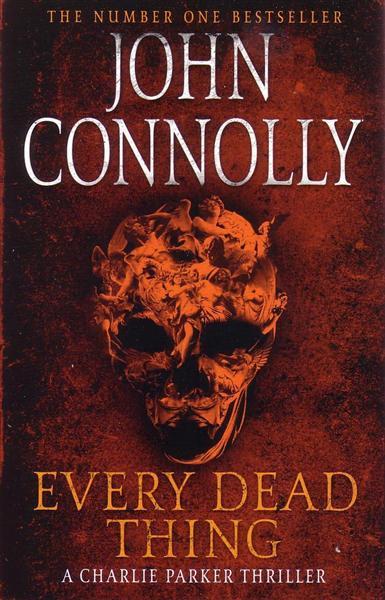


Thanks to my local library's database revealing his books as 'horror/crime' I picked up a copy of THE WHISPERERS, which turned out to be the tenth novel featuring his detective creation Charlie Parker. What sold me on giving it a go was the mention of supernatural elements worked into a crime story, which is exactly what I got. However, despite the overt reference to demons and unnatural happenings, it was Charlie Parker himself who grabbed me. A lot of the book doesn't follow his point of view, and I found those bits a little dull. They were well-written, don't get me wrong, but Parker's personality is so strong it made everything else pale in comparison.
Parker's a haunted man, but also possessed of a strong wit and driving need to see justice done. He exudes a paradoxical menace; dangerous to know but also the sort of person you feel safe having on your side. I was so enamoured with his adventures I immediately set about trying to get hold of the rest of the Parker series. His "gimmick", if you will, is sharing a name with a famous jazz musician, so that he's often nicknamed 'Bird'. Thankfully, this conceit rapidly fades away (I don't think anyone calls him that in the last few novels at all) and the character gets to stand on his own two feet.
Thanks to someone in my area obviously following the same path, I read a few of the novels in a random order, but have since managed to read everything up to THE BLACK ANGEL (the fifth novel) and after THE UNQUIET (the sixth novel - both of these are packed and ready to read on my travels, when I leave the country at the end of this month), save the short stories that feature in some of Connolly's anthologies. THE WHISPERERS remains, I think, the weakest of the lot, though it's a clear testament to Connolly's writing that it still made me want to read more.

Throughout the series, supernatural elements come into play, though with varying degrees of success. Perhaps my favourite novel - in terms of crime plot - is THE BURNING SOUL. In this one, a young girl goes missing from a small town and an unassuming accountant with a dark past hires Parker to help figure out if someone knows about this and/or is looking to pin the crime on him. The supernatural aspects are practically non-existent but the way certain characters are shown to be less savoury than they appear more than makes up for this.
This is followed by an exceptionally supernatural tale, THE WRATH OF ANGELS, in which previous characters and questions as to Parker's past and 'uncanny nature' come to light in a story that also explicitly features a buried, malevolent god. Great stuff. THE WOLF IN WINTER follows this with an intriguing, though ultimately squandered, tale of a town that feeds women to another, different, buried entity.

However, events in this book lead into A SONG OF SHADOWS, which I'm currently reading. It's another one like THE WHISPERERS in that, so far, Conolly is keeping the action removed from Parker's viewpoint; effectively, making him a character in his own story. This has worked well before, (particularly in THE REAPERS, which focused on Louis and Angel - Parker's best friends and thoroughly dangerous accomplices) though here it can't help but create a kind of impatience: we know, from many of the other books, how Parker tends to come across to others, but how is his current situation affecting him directly? What is going through his mind right now, as he takes it upon himself to investigate the discovery of a corpse on the beach near his current hideaway?

I can't wait to find out, though. From all accounts his latest, brand new, book, A TIME OF TORMENT, is an excellent jumping-on point for new readers, but I'd recommend THE LOVERS, before going back to the beginning with EVERY DEAD THING. THE LOVERS deals with Parker's childhood and the suicide of his father, which is mentioned quite a few times beforehand, though the events surrounding his dad's death feature a heavy supernatural component that gets repeated/referenced in later novels. It works as a decent standalone story but also gives that sense of intrigue that makes reading the preceding books that little bit more interesting: Parker is touched by the unnatural from the very beginning, so in what ways will it manifest going forward?
And now, to finish, how can I not link to his namesake? I CAN'T. So here you go:
Monday, 17 October 2016
AN ARMY OF TILDA SWINTONS

Imagine you're around nine years old and you live in a desolate coastal community surrounded by other young boys and a ton of women with the same disconcerting androgyny of Tilda Swinton. Congratulations: you're Nicholas, the protagonist of EVOLUTION, a super weird recent French film.

The film opens with young Nicholas swimming in the sea and discovering a drowned body. There's a vibrant red starfish on the corpse's stomach, which fascinates Nicholas, and is just one of many references to aquatic life scattered throughout the film. However, when he informs one of the community's many female(?) 'caretakers' of his discovery, all they bring back to the surface is the starfish - apparently, he imagined the body.
And so we have the start of a possible conspiracy and Nicholas' slowly dawning realisation that something isn't right...

The first few minutes of EVOLUTION also brings in the overarching style of the piece: that is, long, static shots; underwater photography, the incessant rumble and whoosh of waves and wind; and a score reminiscent of the BBC Radiophonic Workshop. There isn't anything to anchor the events/setting to any particular time or place, which is clearly done on purpose. Even the fact the characters speak French doesn't necessarily mean they're in France - we find out if this is an island, coastal community or somewhere else by the end of the film, but even then there's no clear sense of geography. EVOLUTION is removed from our time and place yet exists within it.

In a previous post I mentioned Lovecraft in relation to this film, which feels both wrong and right. Apart from the sea motifs and setting, it's perhaps closer to the work of fellow French director Jean-Pierre Jeunet (THE CITY OF LOST CHILDREN) with its surreal atmosphere and sickly green hue. Is it otherwordly? It feels more disconnected than that, as lengthy stretches of ambient sounds and forlorn stares serve to distance characters from each other as much as the audience. EVOLUTION's director Lucile Hadžihalilović wastes no time in presenting a very self-contained world, yet leaves an strong undercurrent of ambiguity that may put a lot of people off.

All the children are sick (or are they?). All the 'women' are nurses and/or mothers (or are they?). Nicholas regularly sketches pictures of animals, vehicles, etc, so he clearly has an understanding of the outside world - did he come from there or has he seen/been shown these images some other way? Why aren't there any older men? Why do the nurses regularly watch the video of someone giving birth? This is a film less about typical plot and more about mood, about texture.

Water pools in dank corridors. Green paint flakes from walls like old skin. The 'hospital' and homes are borderline derelict, yet the equipment used appears to be in good condition. This desolation, unfortunately, also causes the film to have an inherent coldness that, whilst not exactly bleak, adds a further emotional distance between the characters and ourselves. It is a film to admire rather than like; it's difficult to identify with anyone because it all so unsettling (there is a strong sexual aspect to a lot of the character interactions) and no one quite acts like a normal person. The women are aloof and stern, the children perplexed yet obedient - if EVOLUTION were a person itself, it'd be stoic. And possibly hide tentacles under his/her clothes.
I do, however, recommend it. What I don't recommend is that you watch the trailer. It effectively condenses an already sparse film down to something that betrays the fact it would have worked perfectly well as a short film. Allow yourself to experience this one in the dark, alone and possibly a little tired.
Here's some music from the film, which should give you a pretty good idea of the sort of atmosphere it revels in:
Here's some music from the film, which should give you a pretty good idea of the sort of atmosphere it revels in:
ps. I have a theory about what's going, which if you're interested is hidden below in tiny, tiny writing:
--------------------------------------------------------------
The women are the results of a previous experiment, and are themselves trying to replicate the results using the bodies of the young boys. With reference to certain sea creatures' sexual properties, it's possible the goal is to create a lifeform/version of a person capable of creating their own offspring. Except, they're still learning/experimenting, which is why we see them watching a birth video and collecting the 'failures' in jars. What do you think?
-------------------------------------------------------------
Friday, 2 September 2016
LEMON TREE PASSAGE IS THE MOST ANNOYING FILM I'VE SEEN IN AGES
I can put up with a lot of nonsense in horror films. I can suspend my disbelief to quite a substantial extent. But only if the filmmakers give me some compelling reason to do so, and having a flagrant disregard for narrative is most definitely not a reason. Say hello to LEMON TREE PASSAGE (2014).

And then quickly say goodbye to it, because it's confusing rubbish.
It starts promisingly enough, and is a fantastically lovely looking film throughout (which you'd expect, since this comes from two former ad men) but it's like finding out that pretty girl at the party has a habit of missing out entire sentences during conversation, and as such leaves you wondering quite what she's on about. EXACTLY.
Three American backpackers are chilling out on a beach in New South Wales, where they meet two friendly Australian lads. Soon they're swapping spooky stories around a campfire and this is where we're introduced to the tragic story of Lemon Tree Passage (which is a real place). Apparently, if motorists speed down it they see ghostly phenomena, in part due to a supposed accident in which a motorcyclist was killed by another vehicle.
Of course, they all decide to go speed down this road and, sure enough, they all (well, almost all of them) see a weird bright light behind them. "Okay," you think, "they've disturbed the motorcyclist's ghost and now it's going to get them." That's even what the official synopsis says. But hang on just a minute!
The film starts with this rubbish Youtube clip:
https://www.youtube.com/watch?v=UmAynGPEL9w
and then a kind of 'prologue' in which a skinhead is bothered by a ghost in his garage. Then we meet the main characters and it all flows quite naturally. Although, hang on, back at the nice Australian lads' house we find out they live with the skinhead from earlier. THAT'S WEIRD. And now what's this? The one tourist who claimed not to see the ghostly light is now having visions of, it appears, a car of teenagers? THAT'S WEIRD.
Deciding to properly document the spooky light, they go back to the road in question, where one of the Australians promptly disappears. Meanwhile, back at the house, Skinhead Housemate is being bothered by more ghostly visions. Wait, what. But he didn't go with them before, so why is he...? THAT'S WEIRD.
It doesn't take long from this point for the characters to stop acting even remotely like real people and purely as creatures who serve the plot. No explicit spoilers, in case you're mental and feel the need to find out for yourself, but you would think that, after finding your friends dead, the last thing you'd do is take the time to set up a campfire (a big no-no in Australia anyway) and sleep in the very same woods your friends were just MURDERED IN.
And if it's a ghost they've woken up, why is bothering Skinhead Housemate? Is it even the same spirit? And why was it bothering him before they drove down the road? And if it is capable of giving people scary visions to fuck with them and make them truly believe they're bleeding, etc, before abruptly reverting everything back to normal (which is actually a pretty cool idea) AND it can move objects like, you know, a ghost, why OH WHY does it then feel the need to make a really, really lame booby trap? THE GHOST MAKES A BOOBY TRAP.
IT MAKES A BOOBY TRAP.
I can't even.
Okay, so the person killed in this manner is shown to reference another death, except that death doesn't actually involve an actual booby trap set-up. I just...WHAT IS GOING ON.
The biggest sin LEMON TREE PASSAGE commits is that it purposefully withholds information from the audience. This does not generate tension, but instead is a slap in the face to that very same audience. Is it just one ghost? Why is it being, apparently, sympathetic to that one person but then acts vengeful towards others? Why is Skinhead Housemate now in the same woods? Why is the ghost telling him to find one of the characters when it, er, has clearly found them already? Why, after two people are shown running away, in the next scene is one of them now inexplicably tied to a tree? AND WHERE IS ALL THE ROPE COMING FROM?
Why is all this happening?
It's because the filmmakers hate you. They hate you, and think that pulling all these "tricks" and refusing to establish clear rules for the threat (or even the clear nature of it, as suddenly this ghost can possess people so OH WHAT I GIVE UP). I give up.All they had to do was include a few extra scenes to show exactly how Skinhead scratch all that. No amount of extra scenes could stop the characters from acting like non-people, or adequately explain why the filmmakers are so hellbent on pretending to tell two completely different stories when the actual story would be a fully worthwhile idea if properly focused on.
But something that really bothered me is, the road just doesn't feel remote. There are plenty of places here (in Australia) where you could drive for a while and only see trees (typically when you're driving past/through a national park), but there are several points in the film where I got the impression they were remarkably close to civilisation (including an end shot that shows adjacent farm fields). I thought "Maybe that's just me. Maybe it is a surprisingly remote road." But it isn't. Look at this map. There are very few points where there's just trees/fields - ie. it really wouldn't take a person on foot too long to reach help.
LEMON TREE PASSAGE starts with a decent idea but then thoroughly pisses it away. Or rather, pisses in the face of the audience. It's riddled with confusing scene transitions, incoherent structure, far-too-coincidental clues (a bloody PHOTOCOPY OF A NEWSPAPER ARTICLE? Are you serious? Not only AN ARTICLE THAT EXPLICITLY STATES WHO THE GHOST IS but for some weird reason it's a PHOTOCOPY. Why has the ghost PHOTOCOPIED IT?) and oh yeah A GHOST THAT MAKES A BOOBY TRAP.
I give this film -657908 out of a possible 100968745.

And then quickly say goodbye to it, because it's confusing rubbish.
It starts promisingly enough, and is a fantastically lovely looking film throughout (which you'd expect, since this comes from two former ad men) but it's like finding out that pretty girl at the party has a habit of missing out entire sentences during conversation, and as such leaves you wondering quite what she's on about. EXACTLY.
Three American backpackers are chilling out on a beach in New South Wales, where they meet two friendly Australian lads. Soon they're swapping spooky stories around a campfire and this is where we're introduced to the tragic story of Lemon Tree Passage (which is a real place). Apparently, if motorists speed down it they see ghostly phenomena, in part due to a supposed accident in which a motorcyclist was killed by another vehicle.
Of course, they all decide to go speed down this road and, sure enough, they all (well, almost all of them) see a weird bright light behind them. "Okay," you think, "they've disturbed the motorcyclist's ghost and now it's going to get them." That's even what the official synopsis says. But hang on just a minute!
The film starts with this rubbish Youtube clip:
https://www.youtube.com/watch?v=UmAynGPEL9w
and then a kind of 'prologue' in which a skinhead is bothered by a ghost in his garage. Then we meet the main characters and it all flows quite naturally. Although, hang on, back at the nice Australian lads' house we find out they live with the skinhead from earlier. THAT'S WEIRD. And now what's this? The one tourist who claimed not to see the ghostly light is now having visions of, it appears, a car of teenagers? THAT'S WEIRD.
Deciding to properly document the spooky light, they go back to the road in question, where one of the Australians promptly disappears. Meanwhile, back at the house, Skinhead Housemate is being bothered by more ghostly visions. Wait, what. But he didn't go with them before, so why is he...? THAT'S WEIRD.
It doesn't take long from this point for the characters to stop acting even remotely like real people and purely as creatures who serve the plot. No explicit spoilers, in case you're mental and feel the need to find out for yourself, but you would think that, after finding your friends dead, the last thing you'd do is take the time to set up a campfire (a big no-no in Australia anyway) and sleep in the very same woods your friends were just MURDERED IN.
And if it's a ghost they've woken up, why is bothering Skinhead Housemate? Is it even the same spirit? And why was it bothering him before they drove down the road? And if it is capable of giving people scary visions to fuck with them and make them truly believe they're bleeding, etc, before abruptly reverting everything back to normal (which is actually a pretty cool idea) AND it can move objects like, you know, a ghost, why OH WHY does it then feel the need to make a really, really lame booby trap? THE GHOST MAKES A BOOBY TRAP.
IT MAKES A BOOBY TRAP.
I can't even.
Okay, so the person killed in this manner is shown to reference another death, except that death doesn't actually involve an actual booby trap set-up. I just...WHAT IS GOING ON.
The biggest sin LEMON TREE PASSAGE commits is that it purposefully withholds information from the audience. This does not generate tension, but instead is a slap in the face to that very same audience. Is it just one ghost? Why is it being, apparently, sympathetic to that one person but then acts vengeful towards others? Why is Skinhead Housemate now in the same woods? Why is the ghost telling him to find one of the characters when it, er, has clearly found them already? Why, after two people are shown running away, in the next scene is one of them now inexplicably tied to a tree? AND WHERE IS ALL THE ROPE COMING FROM?
Why is all this happening?
It's because the filmmakers hate you. They hate you, and think that pulling all these "tricks" and refusing to establish clear rules for the threat (or even the clear nature of it, as suddenly this ghost can possess people so OH WHAT I GIVE UP). I give up.
But something that really bothered me is, the road just doesn't feel remote. There are plenty of places here (in Australia) where you could drive for a while and only see trees (typically when you're driving past/through a national park), but there are several points in the film where I got the impression they were remarkably close to civilisation (including an end shot that shows adjacent farm fields). I thought "Maybe that's just me. Maybe it is a surprisingly remote road." But it isn't. Look at this map. There are very few points where there's just trees/fields - ie. it really wouldn't take a person on foot too long to reach help.
LEMON TREE PASSAGE starts with a decent idea but then thoroughly pisses it away. Or rather, pisses in the face of the audience. It's riddled with confusing scene transitions, incoherent structure, far-too-coincidental clues (a bloody PHOTOCOPY OF A NEWSPAPER ARTICLE? Are you serious? Not only AN ARTICLE THAT EXPLICITLY STATES WHO THE GHOST IS but for some weird reason it's a PHOTOCOPY. Why has the ghost PHOTOCOPIED IT?) and oh yeah A GHOST THAT MAKES A BOOBY TRAP.
I give this film -657908 out of a possible 100968745.
Friday, 26 August 2016
REVIEW: UNTIL THE HORROR GOES (JOHN CONGLETON AND THE NIGHTY NITE)
We are all dying, just at different speeds.

"to me the human condition (the water in which my music tends to swim) is in some ways the slow realization magic does not exist. the idealizations one has as a child are chipped away by the lubrication of life; we slowly discover there is no santa claus, no salvation as we were promised. until the horror goes is in some ways the musical manifestation of that screaming child rejecting the intimacy and connection for which it cries; the endless quest for the sublime uncovering only the inane. the feeling of aloneness in the universe while connecting with everyone else feeling alone and laughing at the simple irony we all feel alone together."
Musician and producer John Congleton continues to earn a place as one of my favourite lyricists with his, technically first, solo album UNTIL THE HORROR GOES. First, in that he's using his own name along with 'and the Nighty Nite', though his name may already be familiar to some from his days fronting discordant indie band THE PAPER CHASE.
Congleton has produced a wide mix of artists from the exuberant hip hop of Missy Elliott to the bludgeoning metal of Tombs, and it is this eclecticism that informs the actual sound of UNTIL THE HORROR GOES. Battering drums and squealing synths give way to distorted beatbox-style percussion and swathes of ethereal keyboards, whereas some songs (such as 'Who Could Love you Lucille?') are almost anti-genre, being as they are almost completely devoid of any coherent, recognisable style other than 'John Congleton being weird'. That is not a criticism.
Congleton has stated in interviews that this album is very much about "the human condition", and luckily for us it's a suitably fatalist view:
(taken from HERE).
It's bleak, but that aforementioned musical eclecticism saves it from being a dirge: 'Animal Rites' starts the album by kicking the door in with pounding drums before throwing up mental keyboards that sound like an old computer game playing freeform sax solos. 'The White Powerless' follows with the suggestion of grinding synths before quickly morphing into a demented 1950s ballad interspersed with blocks of filth. It's like Mr. Bungle have returned and it's glorious.
Following in the footsteps of The Paper Chase's own wilful chaos, I was concerned The Nighty Nite would see John Congleton abandon the skronk (the use of discordance and dissonance to create rhythm) of that band for something more palatable, but thankfully UNTIL THE HORROR GOES presents a different kind of noise. The nightmare orchestral passages from The Paper Chase reappear here but in much smaller, refined doses, as does the dramatic-yet-haunting pianowork. The guitar gymnastics of the past have been replaced by barrages of synth, though there are still guitars used to give certain songs an extra kick or punch.
The biggest difference though, is in tone. Whereas The Paper Chase traded on creeping horror and paranoid menace - threat, in other words - The Nighty Nite is all about the immediate terror and quick realisation of an impending death. There is a LOT of death on this album, and murder. Some of it is explicit, such as in the aforementioned 'Lucille' with Congleton's desperate cry of "Death to everyone!"; other times it's more implied, such as in the haunting closing track 'You Are Facing The Wrong Way' with its refrain of "I require a body bag".
This track in particular deserves to reach the heady heights of the strangely similar 'Hurt' by NIN - a somber lament about losing someone/thing that should never have been lost. "You could have had it all / We held it right in our hands / It's the truth that will slip through your fingers / It's the beauty we could have had" Congleton sings, his voice layered with a fuzzy, warped version of itself. The main difference between Trent Reznor's industrial angst and Congleton's subtle rage, however, is Congleton has this (seemingly) effortless ability to take the theme and content of his songs to an exceptionally bitter place, but one wrapped up in fantastically dark humour. "Some day this could all be yours / But you chose to remain on all fours / An enlightenment that never lingers / An existence without poetry" he continues, sticking a great big middle finger up at the (former?) object of his affections. "Enjoy being alone and miserable" he appears to say, "as you realise things could have been so much better for you."
Sometimes you can even picture him smiling as he sings lines like "You deserve to be eaten / So I hope something eats you" and "The storm is the bastard / Your face is the face it's slapping" as if he's secretly saying "You know what I'm talking about, don't you?" I could spend all day quoting John Congleton lyrics, to be honest, because they're singularly marvellous.
If all this death sounds a tad too dark, a tad too relentless, I suppose it depends on your frame of mind. UNTIL THE HORROR GOES isn't party music, but it still holds a pleasing sing-a-long quality within many of its songs and the playful, unexpected, inclusion of unusual audio textures/production. It's like the severely underrated and unknown Meow Meow, who also excelled in writing perfect indie-pop music that they then purposefully ruined.
"Just stay with me," Congleton sings on the album's title track, "until the horror goes." Except it never ends, does it? Can any of us find someone to stay by our side forever? UNTIL THE HORROR GOES suggests the best way to make sure this happens is if that person becomes a corpse. The body is dead but the memory lives on.
You can stream the whole album for free online here: http://consequenceofsound.net/2016/03/stream-john-congleton-and-the-nighty-nites-new-album-until-the-horror-goes/
Thursday, 11 August 2016
WHITEDAY: YOU GOT SILENT HILL IN MY KOREAN SCHOOL!
There are a whole bunch of wildly different things I'm going to post about, including my thoughts on STRANGER THINGS (I loved it!) and MONSTER TOYS (I love them!) but for now, here's a quick bit of guff about WHITEDAY: A LABYRINTH NAMED SCHOOL (I love that title!).


WHAT IS IT?!
It's a Korean survival horror computery game from 2001 that was never released. So how did I get my hands on it? C'mon, this is the internet; you can get ANYTHING on here. A new version of this is currently being worked on, but for now those with the gumption can (pretty easily, to be fair) find the original.
But WHAT IS IT?!
You're a Korean schoolboy (I called my character Jimmy Jimjams) who pops to his school at 10pm with the intention of returning a diary belonging to a girl he fancies (she drops it near him in the intro cutscene). And also to plant chocolates in her locker or on her desk or something. White Day is March 14th, and is basically a second Valentines Day, which explains the chocolates, but not why little Jimmy Jimjams is doing all this at night time like a mini Korean Cadbury's Milk Tray Man.
The instant Jimmy steps into the school, someone OR SOMETHING WOOOAAAHHH locks him in! But, levelheaded and realising things will probably get quite weird pretty quickly, I sent Jimjams into the toilets to open all the stall doors. Maybe someone would have left something useful in one of them, because video games. But no, all I found was flatly painted floor-toilets:

Shortly after this, I bumped into two female classmates having a giggle. Why were they in the school after hours? I do not know. They didn't seem very impressed by Jimmy's presence though, especially when he started asking them about the girl he fancies. However, all this was cut short by the sudden blare of the fire alarm. One girl legged it, the other hid by a vending machine and covered her ears. I don't think Korean schools have the most effective fire evacuation plans. Being the incomparable Jimmy Jimjams, I used a stepladder and wirecutters to enter the air vent in the ladies bathroom, through which I crawled like Tom Cruise in all the Mission: Impossibles until I reached the room with the fusebox. Which was full of scrap and looked all rusty until I turned the alarm off, then it magically turned spacious and neat. UH OH SPOOKY STUFF.
Oh yeah, and when Jimmy was in the vents he saw the janitor beat the shit out of a man and drag him into the stairwell. STRANGER DANGER.
Jimmy rightly felt like a hero and the girl by the vending machine...didn't really treat him like one. Nevertheless, she did tell him how to get out of the school and gave him a key to aid in his utterly ridiculous quest. But terror reared its bald head! The janitor reappeared and chased Jimmy! Luckily, the girl who'd legged it grabbed Jimjams and pulled him into a hiding spot. Once the coast was clear, the girl did what she did best and ran off again. I was all alone. Jimmy was all alone. We were all alone.
I explored a few rooms and found a few ominous notes concerning ghost stories tied to the school. Ten minutes into the game and I'm already convinced this place is more haunted than every castle in England combined. The sound design also does a good job of giving you the willies, as it's all non-musical eerie effects and whooshy low-pitched loops. But I, and Jimmy Jimjams, will soldier on and brave this creepy, near-empty building in the name of...infatuation? Slightly creepy junior love? Misguided romance? Yeah, let's go with that.
However, the next thing standing in little Jimmy's way is this suspiciously dark hallway:

I just know there's going to be a spooky noise at some random point along here. I just know it.
Until next time, here's this:
Wednesday, 20 July 2016
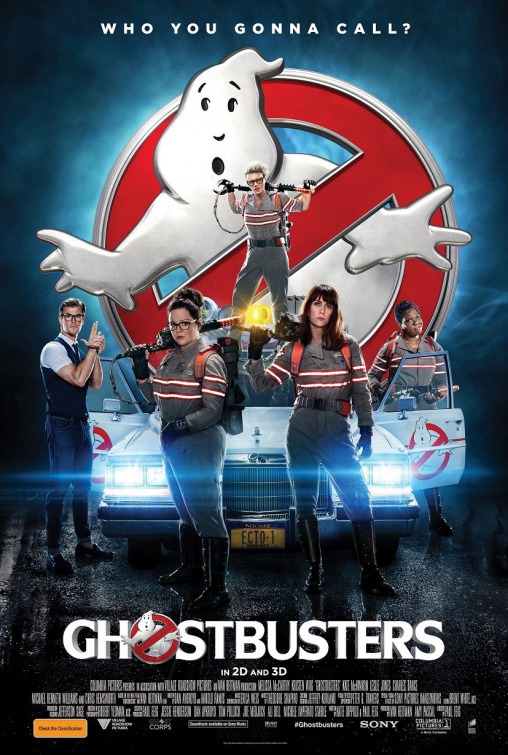
GHOSTBUSTERS: EASY ON THE EYES AND BRAIN
'One sentence' review:
A clumsy start gives way to a fun, if insubstantial, explosion of neon ghosts.
'Significantly more sentences' review:
"Please don't be the Mayor from Jaws" is probably my favourite line from the new GHOSTBUSTERS, and it creates an interesting parallel for the film itself. It's delivered by Erin (Kristen Wiig) as she pleads with the Mayor of New York (Andy Garcia) to do something about the impending ghostly apocalypse. The joke works because we know what the Mayor from Jaws was like, as it is an archetype used in multiple films right to this day - it is familiarity and expectation wrapped up into a one-liner, things that plague this new version of everyone's favourite paranormal investigators in both good and bad ways.
For instance, the NY Mayor knows about the ghosts, and actually has Homeland Security working on the problem. That's a bit different (although later on it looks like HS expect to take the ghosts on with conventional firearms, which doesn't make any sense at all). It's a shame this neat twist on expectations isn't full realized over the course of the film.
After a video of a ghostly encounter in a mansion comes to the attention of her boss, Erin loses her respectable Physics teaching job and ends up forming a paranormal investigations team with her old childhood friend Abby (Melissa McCarthy) and Abby's new colleague Holtzmann (Kate McKinnon). Soon enough they're joined by Kevin (Chris Hemsworth) a fantastically dense beefcake receptionist, and Patty (Leslie Jones) a subway worker who turns up at their office after witnessing a weird glowing bomb-thing explode, followed by an apparition.
Turns out a creepy janitor called Rowan (Neil Casey, all bug-eyed and pasty) is planting the 'ghost bombs' around New York in order to summon spirits. Once he's done this enough times he plans to unleash the aforementioned spooky apocalypse, for reasons and in a manner I won't spoil. I actually quite liked this "villain" even though he wasn't scary or anything, because there are clear echoes of Janosz, the pasty creep from GHOSTBUSTERS II - he's just a weird, vaguely pathetic guy who's finally found a way to get power over those around him.
Of course the general plot will be familiar, since this is a remake (although why on earth they didn't just make a sequel I'll never understand, as it could work so easily) - but the biggest criticism I have is everything's a little too easy. For example, two or three times the Mayor's office publicly labels the Ghostbusters frauds (in an effort to cover up the ghosts, because they don't want mass hysteria) - except this has literally no impact on them at all, save for bemoaning the fact they've been labelled frauds. It doesn't stop people calling them with ghost sightings; it doesn't see them getting booed at or ignored. No effect at all.
Patty displays extensive knowledge of New York, which would make her a perfect fit for the team - except this knowledge is only used to present interesting facts for places the team go to anyway. You could argue she provides context, but it would have made a lot more narrative sense had her knowledge been called on to help figure out where Rowan was using as his 'apocalyptic nexus point'
ie. "He needs somewhere with an extremely high psychic disturbance, but this is New York so that could be anywhere, arf arf!"
"Hey, I can think of a few places, such as THIS and THIS. Let's go INVESTIGATE!"
Erin and Abby, too, start off as enemies (or frenemies) as Abby published a book she wrote with Erin about ghosts, without telling her. This is swept under the carpet pretty quickly and provides zero further tension. Abby does say she's doing it as a revenue stream, except the team have got no money worries at all, aside from not being able to afford the iconic fire station as a base. In the original, they form Ghostbusters as a business as much as due to a desire to investigate ghosts. This version never feels like a business, which might be an odd nitpick, but it ties in with the whole 'easy' notion. They can magically afford to hire a receptionist, rent a place and buy all the clearly specialised scientific stuff Holtzmann needs, even though they've lost their jobs and have no funding.
Holtzmann is this team's Egon (with all her own entertaining idiosyncrasies), and comes up with all the equipment they use to bust the ghosts - although pretty soon all the weapons are capable of obliterating the spirits completely, so they don't even need to bother trapping them. Just zap 'em and move on. Part of the fun/tension of the originals was whether they'd successfully capture the ghosts and just how much damage they'd cause in the process - it was chaos every time they fired up the proton packs. There is also, sadly, no reference to 'crossing the streams' this time around.
Having said that, a couple of the new weapons are pretty cool and Holtzmann gets a moment to shine in the climax with her own special equipment. This sort of trade-off happens throughout - there'll be a weak riff on the original film, followed by a decent use of the new version of things. I do particularly like the way they get their logo, how Rick Moranis's panicked knocking on the fancy restaurant windows is referenced and how the villain's final form is requested/chosen. Almost everything Kevin says or does is delightfully idiotic and the four ladies have excellent on-screen chemistry (as you'd well expect, given their comedic histories). GHOSTBUSTERS is a very easy film to watch, which is both part of its charm and downfall.
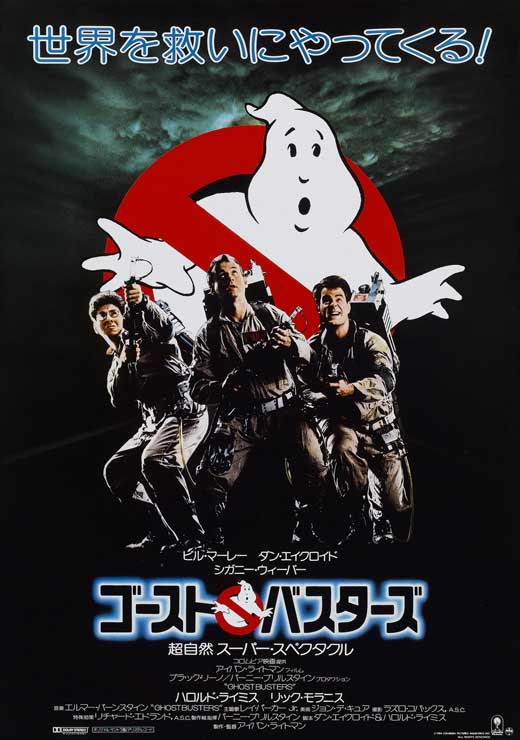
It's also easy to just point at the original film and go "that was better", but why? How? I loved the original ghost effects (and being around 6 years old when I first saw any of it, they scared the crap out of me but also fascinated me - as in "What IS that?"*) but I also like these new neon ghosts, despite the lack of variety and scariness. Are the original films scarier? I would say so, partly due to the general lack of tension and unsettling weirdness in the new version. Plus, there were a few little kids in the screening for the new one, and none of them sounded or looked too bothered by the ghosts, so I'd hazard a guess they didn't find it scary. Although to give credit where it's due, the first ghost made me jump when she changed, even though I knew it was coming haha.
What I do think this film should definitely have kept from the originals is the rich sense of mythology. They could have very, very easily used a copy of Tobin's Spirit Guide to reference the types of manifestations. In the originals, there's 'real' history and menace to the ghosts - in this one, they're just ghosts. Not ancient gods or conquerors. Just...ghosts.
However, and in case it reads like I'm being grumpy in a "the original is far superior wah wah wah" way, this lack of substance is actually what helps make the new version so easy to take in. The special effects are cool to look at and it doesn't tax your brain to figure anything out. Stuff just happens. The team feels like a team. Some jokes are terrible but there are more than enough decent ones thrown in - the script is at its funniest when the humour comes from the situation, rather than when a character is clearly making a joke. The cameos from the original cast (minus Moranis) are fun to look out for.
As a final thought, despite one (actually decent) joke involving terrorism, this film is remarkably free of any real world terror. You'd think finding a bomb-like thing shooting out weird neon light in a subway tunnel would cause total panic, or there might be the suggestion that the ghosts could be a symptom of a chemical weapon, etc etc etc but thankfully the film never goes this route. They're ghosts and they're real. It is refreshing, in a world where news and social media offer a constant barrage of horror and fear, to be able to spend two hours soaking up pure escapism. And I cannot see anything wrong with that at all.
I give the new GHOSTBUSTERS a rating of ONE AND A HALF THUMBS UP or IT HAS IT'S FAULTS BUT THAT DOESN'T DEPRIVE THE FILM OF ITS OVERALL FUN IMPACT AND IF YOU THOUGHT THE POST TITLE WAS GOING TO MAKE SOME REMARK ON GENDER SHAME ON YOU.
nb. from what I heard of it in the movie, the new theme tune by Fallout Boy and Missy Elliott didn't sound too bad (and if you've been eyeballing this blog long enough it's pretty evident that my taste is a lot darker/weirder than them), although I do really enjoy this "trailer" theme:
* I distinctly recall being at junior school in London and one of my friends brought a Scholastic Ghostbusters book in to show us all, that had loads of photos from the film in it. We were all scared by the library ghost's monstrous form and took it in turns daring each other to open the book at that page and look for as long as possible at the photo. And now look at me hahaha
Wednesday, 24 February 2016
THE ONE WHERE I REVIEW A FILM CALLED SPRING FROM 2014
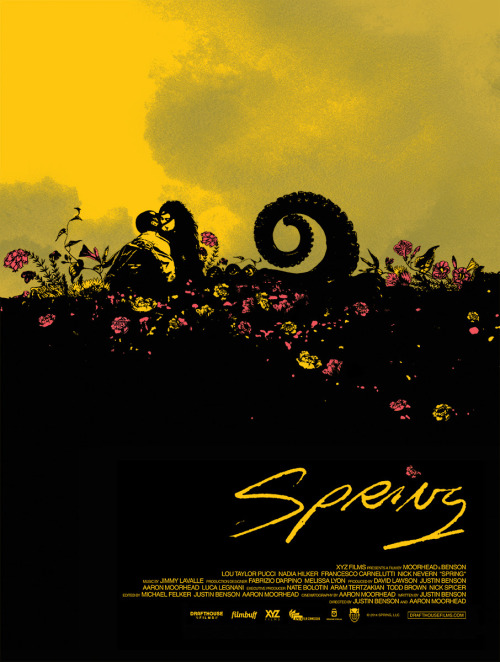
More and more over these last six months, I'm finding myself significantly affected by films, TV shows and books with an emotional weight. You might think that's an obvious thing to say, but what I mean is, whereas before I could appreciate if something had an emotional storyline, nowadays it actually has an emotional effect on me. Perhaps unsurprisingly (given that I currently live in a different country to my wife) stories involve love, or lost love, have the most profound impact (case in point: VENISS UNDERGROUND by Jeff Vandermeer). Which is all a lead-up to say that SPRING (2014) is about love and it got me right in the feels.

The film follows a Californian man named Evan, who, after the death of his mother, jets off to Italy to clear his head. There he encounters Louise, an intriguing European woman fascinated by evolutionary genetics. Before too long, it becomes apparent there is something unnatural about her, and the question becomes one of: when will Evan find out, and how will he respond?
Film-makers Justin Benson and Aaron Moorhead garnered attention with their debut RESOLUTION (2012), a seriously weird film about a man helping his best friend go cold turkey in a cabin. Before too long it becomes apparent that they're being watched, possibly by something deeply sinister. RESOLUTION plays with perception in a manner akin to Michael Haneke's excellent HIDDEN and spirals into one of the most WTF endings I've ever seen.
With this, their second feature, they toy with perception in different ways. Is Louise playing hard to get? Is she actually dangerous, or controlled by her strange nature? It asks questions of love, of lust, of whether we can truly claim to know or feel something for someone we've just met. The obvious answer is 'of course not' but what about that that ineffable sense of truth that accompanies real love? When we know on an emotional level that can't be measured that this relationship, this person, is right...?
This desperation, this need to be with someone, to know, to prove they're the right person, flows throughout the latter half of the film. Evan understands it's crazy to tell someone after only five days he loves them, and Louise suggests his recent grief is clouding his judgement, but what if it took the death of a loved one to make him realise what he wants/needs from life, from a partner?
Grief underpins SPRING. Throughout, we're reminded that Evan is lost, emotionally, and that grief affects people differently - there is a poignant side story involving an elderly Italian farmer Evan finds work for, who himself is dealing with the death of a loved one (in a very quiet, dignified way). , Though it sinks into the background, death and its repercussions haunt the film in subtle ways; at one point, Louise and Evan head to several ancient graveyards, including one with mummified remains on clear display. It's eerie and fascinating in equal measure, like Louise herself.
It's not spoiling anything to tell you Evan discovers Louise's monstrous secret - after all, the point of the film is he finds out - but how he does, and how he reacts, are what makes things interesting. The film then hinges on the question: how willing are you to accept another person for what they are, if you truly love them?
This is a particularly interesting question to raise in the context of a love story. Plenty of romcoms and dramas answer it, of course, but rarely in such an intriguing or realistic way. Usually, there's the 'acceptance' of a person's 'faults' but no actual acknowledgement of what this acceptance really means. If the issue is so dark, so terrible that even thinking about it is difficult, what does 'acceptance' mean in this regard? It means acknowledging that the issue might fade from thought but never from memory, that its implications and/or consequences may well last the rest of your life. And that you are prepared to stand by that person, to support them in any way you can. It is a chance to show that love is/should/can be unconditional/non-judgemental.
The fx in SPRING are almost all pleasingly physical, with the CGI looking uncanny in the right way (an early shot of Louise's transformed form, with its uncomfortable bone structure and staccato movements, is unnervingly creepy). I thought after the first few times I'd seen all there was and, after hearing Lovecraft mentioned (and seeing the recurrent use of certain animal parts in publicity material) I was a little disappointed. But stick with it and you'll be rewarded with a suitably unique "monster" design.
Lovecraft isn't too bad a touchstone, in that Louise's condition has physical characteristics of some of his creations, there are plenty of shots of the ocean, and it all appears to take place in a small seaside town. There is also the terror of the unknown, of what is the actual cause of Louise's condition, though don't go in expecting huge inter-dimensional gods to pop up and everyone to go mad.
As much as I enjoyed all this ^ what I really liked, and took me by surprise, was the sense of humour in SPRING. Evan's best friend is a drunk/stoner but supportive in his own way and very quick to remind Evan that he loves him, which was a really sweet touch. Once Evan reaches Italy he tags along with a couple of boisterous English lads who are all about "booze and birds" - I've known plenty of lads like them and their characters were spot on, though thankfully lacking the (easy) hooligan aspects of typical wideboys. There are some genuine laughs in SPRING, which helps make it all feel grounded and real - it's a dark, sombre film but clearly set in our reality (despite all the weird stuff).
Why exactly SPRING works is easy to quantify: it treats all its themes (think about what the season of 'spring' typically means) with respect and blends styles so that no one genre has precedence over another. There are plenty of nice story touches (such as the apparent supernatural aspects of Louise's condition and her logic against them) and sweeping camera shots that speak of a confidence in the film-makers that they knew exactly what they wanted to make so they damn well made it.
(I was actually reminded quite a bit of the James Earl Jones b-movie BLOOD TIDE, so here's a song referencing that film:)
The film follows a Californian man named Evan, who, after the death of his mother, jets off to Italy to clear his head. There he encounters Louise, an intriguing European woman fascinated by evolutionary genetics. Before too long, it becomes apparent there is something unnatural about her, and the question becomes one of: when will Evan find out, and how will he respond?
Film-makers Justin Benson and Aaron Moorhead garnered attention with their debut RESOLUTION (2012), a seriously weird film about a man helping his best friend go cold turkey in a cabin. Before too long it becomes apparent that they're being watched, possibly by something deeply sinister. RESOLUTION plays with perception in a manner akin to Michael Haneke's excellent HIDDEN and spirals into one of the most WTF endings I've ever seen.
With this, their second feature, they toy with perception in different ways. Is Louise playing hard to get? Is she actually dangerous, or controlled by her strange nature? It asks questions of love, of lust, of whether we can truly claim to know or feel something for someone we've just met. The obvious answer is 'of course not' but what about that that ineffable sense of truth that accompanies real love? When we know on an emotional level that can't be measured that this relationship, this person, is right...?
This desperation, this need to be with someone, to know, to prove they're the right person, flows throughout the latter half of the film. Evan understands it's crazy to tell someone after only five days he loves them, and Louise suggests his recent grief is clouding his judgement, but what if it took the death of a loved one to make him realise what he wants/needs from life, from a partner?
Grief underpins SPRING. Throughout, we're reminded that Evan is lost, emotionally, and that grief affects people differently - there is a poignant side story involving an elderly Italian farmer Evan finds work for, who himself is dealing with the death of a loved one (in a very quiet, dignified way). , Though it sinks into the background, death and its repercussions haunt the film in subtle ways; at one point, Louise and Evan head to several ancient graveyards, including one with mummified remains on clear display. It's eerie and fascinating in equal measure, like Louise herself.
It's not spoiling anything to tell you Evan discovers Louise's monstrous secret - after all, the point of the film is he finds out - but how he does, and how he reacts, are what makes things interesting. The film then hinges on the question: how willing are you to accept another person for what they are, if you truly love them?
This is a particularly interesting question to raise in the context of a love story. Plenty of romcoms and dramas answer it, of course, but rarely in such an intriguing or realistic way. Usually, there's the 'acceptance' of a person's 'faults' but no actual acknowledgement of what this acceptance really means. If the issue is so dark, so terrible that even thinking about it is difficult, what does 'acceptance' mean in this regard? It means acknowledging that the issue might fade from thought but never from memory, that its implications and/or consequences may well last the rest of your life. And that you are prepared to stand by that person, to support them in any way you can. It is a chance to show that love is/should/can be unconditional/non-judgemental.
The fx in SPRING are almost all pleasingly physical, with the CGI looking uncanny in the right way (an early shot of Louise's transformed form, with its uncomfortable bone structure and staccato movements, is unnervingly creepy). I thought after the first few times I'd seen all there was and, after hearing Lovecraft mentioned (and seeing the recurrent use of certain animal parts in publicity material) I was a little disappointed. But stick with it and you'll be rewarded with a suitably unique "monster" design.
Lovecraft isn't too bad a touchstone, in that Louise's condition has physical characteristics of some of his creations, there are plenty of shots of the ocean, and it all appears to take place in a small seaside town. There is also the terror of the unknown, of what is the actual cause of Louise's condition, though don't go in expecting huge inter-dimensional gods to pop up and everyone to go mad.
As much as I enjoyed all this ^ what I really liked, and took me by surprise, was the sense of humour in SPRING. Evan's best friend is a drunk/stoner but supportive in his own way and very quick to remind Evan that he loves him, which was a really sweet touch. Once Evan reaches Italy he tags along with a couple of boisterous English lads who are all about "booze and birds" - I've known plenty of lads like them and their characters were spot on, though thankfully lacking the (easy) hooligan aspects of typical wideboys. There are some genuine laughs in SPRING, which helps make it all feel grounded and real - it's a dark, sombre film but clearly set in our reality (despite all the weird stuff).
Why exactly SPRING works is easy to quantify: it treats all its themes (think about what the season of 'spring' typically means) with respect and blends styles so that no one genre has precedence over another. There are plenty of nice story touches (such as the apparent supernatural aspects of Louise's condition and her logic against them) and sweeping camera shots that speak of a confidence in the film-makers that they knew exactly what they wanted to make so they damn well made it.
(I was actually reminded quite a bit of the James Earl Jones b-movie BLOOD TIDE, so here's a song referencing that film:)
Tuesday, 23 February 2016
THE ONE WHERE I TALK ABOUT DEADPOOL
Ahoy-hoy. Surely by now every man and his dog's given DEADPOOL a good old eyeball? Wait, you haven't? What is wrong with you! Are you as crazy in the coconut as our eponymous anti-hero? Or maybe you look like 'two avocados had violent sex' so don't like to go out in public? In any case, there is something seriously wrong with you.

From the frankly brilliant marketing campaign it was apparent everyone involved knew what they were doing. Deadpool the film and Deadpool the character know exactly what they are and run with it until their legs drop off (but then grow back). The trailers and word-of-mouth may have convinced you this is a film by and for 13 year old boys, but I say to you, don't listen to that easy and cheap insult/compliment! True, there're plenty of boobs, guns and swears but it's important to note that there is also an actual story here.
After mercenary Wade Wilson finds out he's riddled with cancer, he decides the most heroic thing to do would be to save his fiancée from all the grief and pain of dealing with it, by leaving her. Cue a trip to an experimental "superhero camp" and a few revelations about the place, and before you know it Wade Wilson's reborn as the fourth-wall breaking anti-hero who just won't shut up.
From the frankly brilliant marketing campaign it was apparent everyone involved knew what they were doing. Deadpool the film and Deadpool the character know exactly what they are and run with it until their legs drop off (but then grow back). The trailers and word-of-mouth may have convinced you this is a film by and for 13 year old boys, but I say to you, don't listen to that easy and cheap insult/compliment! True, there're plenty of boobs, guns and swears but it's important to note that there is also an actual story here.
After mercenary Wade Wilson finds out he's riddled with cancer, he decides the most heroic thing to do would be to save his fiancée from all the grief and pain of dealing with it, by leaving her. Cue a trip to an experimental "superhero camp" and a few revelations about the place, and before you know it Wade Wilson's reborn as the fourth-wall breaking anti-hero who just won't shut up.
To say too much more
would spoil things, not because there are any particular plot twists
but rather, this is a film whose exuberance you're best experiencing
for yourself. Everything is delivered with exceptional style and wit,
so much so that you might be too busy admiring how nuts a particular
fight scene is you miss a few one-liners—I recently watched it for
the second time and caught a few jokes and visual gags I missed the
first time.
It's true that the
copious trailers and excellent marketing have given a fair bit of the
film away, and part of me wishes I could go back in time and pay very
little attention to these, so if you can avoid them I'd recommend it.
Save as many of the jokes as possible for your first viewing. If
you're not keen on bum and willy jokes, maybe this film's not for
you, but there's undeniably a sense of demented charm in immersing
yourself in a world populated by a foul-mouthed and excessively
violent anti-hero. There are insults and deaths in this film I
guarantee you've never heard or seen before. Probably. I don't know what
you've watched, do I? Give me a break.
Are the villains a bit boring? Yes. Do some jokes miss the mark? A few. Does it get as irritating as people tend to find Deadpool himself? Absolutely not.
I think the best recommendation I could give is that my mum really enjoyed it. The second-best recommendation I could give is that DEADPOOL is smart at playing dumb. It also has the BEST superhero rap song I've heard in a long time.
THREE THUMBS UP!
And to end, here's the second-best superhero rap song I've ever heard:
Thursday, 11 February 2016
THE ONE WHERE I TALK ABOUT A BOOK SERIES I'M READING
Hello there. I don't
have an awful lot of internet access so I don't get to update this as
much as I want. However, here I am right now so make the most of it,
like I'm your partner and you haven't spoken to me in weeks. Cherish
me, Internet. CHERISH ME AND MY WORDS.

I like to read. Of
course I do. What sort of writer doesn't? A TERRIBLE ONE, that's
what! I mean, who! In order to broaden my horizons, I started to
actively pick random books from my local library to read. Some were
so mundane I can't even remember them, but others were a lot more
intriguing. Case in point: the work of John Connolly. Or more
precisely, his Charlie Parker series.
I stumbled across this
author by searching on the library's database for 'horror
anthologies' – they didn't have his Nocturnes collection checked
in, but they did have THE WHISPERERS, so I gave that a go. The
premise sounded a little dull – someone's smuggling artefacts
stolen from the Middle East – but the promise of 'unnatural' horror
reeled me in none-the-less.
The book itself took a
little getting into, as it takes several chapters before it turns to
the point of view of ex-cop Charlie Parker – in this book, he's
lost his PI licence after the events in a previous book, and is
trying to figure out quite what to do. And then he's asked to look
into the suicide of a former soldier, which sets him on a path that
ends in very explicit supernatural horror (though not a gratuitous
amount). All the stuff in the Middle East was a bit boring, but as
soon as we're in Parker's head the story comes alive. He's a man
transformed by past tragedy into a relentless machine fuelled by the
pursuit of justice, but this is leavened with a sharp wit and
down-to-earth approach to the more macabre elements of the story/his
world that really appealed to me.
THE WHISPERERS is the
tenth Charlie Parker novel and has plenty of mentions of past
adventures, and those he encountered. One such character in
particular plays an integral (though low key) role in this story. I
enjoyed the book but only really when Parker's narrating events –
this was a character I wanted to spend more time with. So, back to
the library where I found THE LOVERS (as luck would have it, the
ninth book in the series).
This was a lot better.
Some chapters still abandon Parker's point of view in order to detail
events, but the overall plot of two, apparently resurrected, killers
with ties to Parker's familial past was far more engaging than the
follow-up book. Was this a sign that John Connolly's work is better
earlier on? I wanted to find out (as well as learn more about the
various cases touched by the unnatural that Parker finds himself
embroiled in).
This time the library
had THE KILLING KIND and THE WHITE ROAD available. Both from earlier
in the series and, as luck would have it, the third and fourth
Charlie Parker novels, respectively. I've just finished THE KILLING
KIND and, although there are touches of the supernatural, it's more
about twisted humans than any kind of demonic entity or group –
yet, it still felt refreshing and exciting to read. Basically, when a
load of human bones are uncovered by a remote lake, it sets off a
chain of events involving a 1960s religious commune, a conspiracy,
and a creepy maniac obsessed with deadly spiders and insects. There
are very few interstitial chapters removed from Parker's POV, which I
think greatly helped the flow. Not that I think John Connolly's
writing suffers when he turns to a typical third person omniscient
view, but when you're leaving behind someone with as much character
as Parker, you feel it.
In any case, it's
exciting (for me) to have a new series worth checking out and hunting
down, especially considering it's classed as a contemporary
'thriller/crime' series, which typically I find quite boring (though
I enjoy older pulp crime stories). I'm going to start on THE WHITE
ROAD today, and have just picked up THE REAPERS (which is set just
before THE LOVERS) and EVERY DEAD THING (the very first Parker novel)
so have those to get stuck into, too. Watch out for more opinions!
WATCH OUT!
Subscribe to:
Posts (Atom)