WHO?!?!?!

Welcome to Reverend Wayne Austin Goodchild's official blog. Not that there's an unofficial one...

Click WAYNE GOODCHILD IS HAUNTED to go to his Facebook page! There's good stuff on it! Honest!

...all work on here is copyright wayne goodchild, unless otherwise stated, you cheeky monkeys...

Showing posts with label Lovecraft. Show all posts

Monday, 17 October 2016

AN ARMY OF TILDA SWINTONS


Imagine you're around nine years old and you live in a desolate coastal community surrounded by other young boys and a ton of women with the same disconcerting androgyny of Tilda Swinton. Congratulations: you're Nicholas, the protagonist of EVOLUTION, a super weird recent French film.


The film opens with young Nicholas swimming in the sea and discovering a drowned body. There's a vibrant red starfish on the corpse's stomach, which fascinates Nicholas, and is just one of many references to aquatic life scattered throughout the film. However, when he informs one of the community's many female(?) 'caretakers' of his discovery, all they bring back to the surface is the starfish - apparently, he imagined the body. 

And so we have the start of a possible conspiracy and Nicholas' slowly dawning realisation that something isn't right...


The first few minutes of EVOLUTION also brings in the overarching style of the piece: that is, long, static shots; underwater photography, the incessant rumble and whoosh of waves and wind; and a score reminiscent of the BBC Radiophonic Workshop. There isn't anything to anchor the events/setting to any particular time or place, which is clearly done on purpose. Even the fact the characters speak French doesn't necessarily mean they're in France - we find out if this is an island, coastal community or somewhere else by the end of the film, but even then there's no clear sense of geography. EVOLUTION is removed from our time and place yet exists within it. 


In a previous post I mentioned Lovecraft in relation to this film, which feels both wrong and right. Apart from the sea motifs and setting, it's perhaps closer to the work of fellow French director Jean-Pierre Jeunet (THE CITY OF LOST CHILDREN) with its surreal atmosphere and sickly green hue. Is it otherwordly? It feels more disconnected than that, as lengthy stretches of ambient sounds and forlorn stares serve to distance characters from each other as much as the audience. EVOLUTION's director Lucile Hadžihalilović wastes no time in presenting a very self-contained world, yet leaves an strong undercurrent of ambiguity that may put a lot of people off. 


All the children are sick (or are they?). All the 'women' are nurses and/or mothers (or are they?). Nicholas regularly sketches pictures of animals, vehicles, etc, so he clearly has an understanding of the outside world - did he come from there or has he seen/been shown these images some other way? Why aren't there any older men? Why do the nurses regularly watch the video of someone giving birth? This is a film less about typical plot and more about mood, about texture


Water pools in dank corridors. Green paint flakes from walls like old skin. The 'hospital' and homes are borderline derelict, yet the equipment used appears to be in good condition. This desolation, unfortunately, also causes the film to have an inherent coldness that, whilst not exactly bleak, adds a further emotional distance between the characters and ourselves. It is a film to admire rather than like; it's difficult to identify with anyone because it all so unsettling (there is a strong sexual aspect to a lot of the character interactions) and no one quite acts like a normal person. The women are aloof and stern, the children perplexed yet obedient - if EVOLUTION were a person itself, it'd be stoic. And possibly hide tentacles under his/her clothes.

I do, however, recommend it. What I don't recommend is that you watch the trailer. It effectively condenses an already sparse film down to something that betrays the fact it would have worked perfectly well as a short film. Allow yourself to experience this one in the dark, alone and possibly a little tired.

Here's some music from the film, which should give you a pretty good idea of the sort of atmosphere it revels in:


ps. I have a theory about what's going, which if you're interested is hidden below in tiny, tiny writing:
--------------------------------------------------------------
The women are the results of a previous experiment, and are themselves trying to replicate the results using the bodies of the young boys. With reference to certain sea creatures' sexual properties, it's possible the goal is to create a lifeform/version of a person capable of creating their own offspring. Except, they're still learning/experimenting, which is why we see them watching a birth video and collecting the 'failures' in jars. What do you think?
-------------------------------------------------------------

Wednesday, 24 February 2016

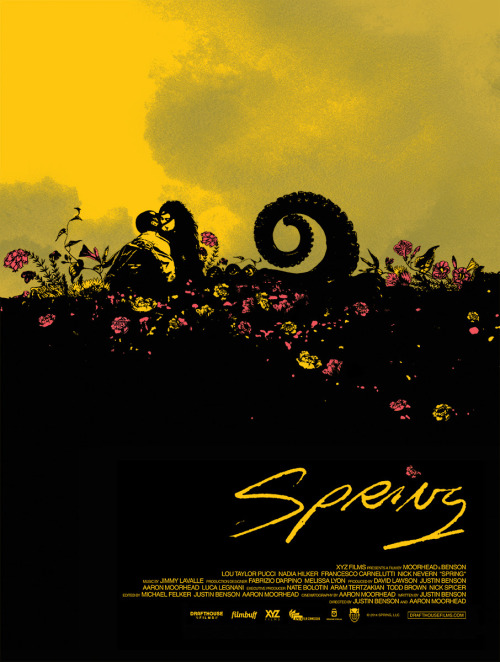
THE ONE WHERE I REVIEW A FILM CALLED SPRING FROM 2014

More and more over these last six months, I'm finding myself significantly affected by films, TV shows and books with an emotional weight. You might think that's an obvious thing to say, but what I mean is, whereas before I could appreciate if something had an emotional storyline, nowadays it actually has an emotional effect on me. Perhaps unsurprisingly (given that I currently live in a different country to my wife) stories involve love, or lost love, have the most profound impact (case in point: VENISS UNDERGROUND by Jeff Vandermeer). Which is all a lead-up to say that SPRING (2014) is about love and it got me right in the feels.


The film follows a Californian man named Evan, who, after the death of his mother, jets off to Italy to clear his head. There he encounters Louise, an intriguing European woman fascinated by evolutionary genetics. Before too long, it becomes apparent there is something unnatural about her, and the question becomes one of: when will Evan find out, and how will he respond?

Film-makers Justin Benson and Aaron Moorhead garnered attention with their debut RESOLUTION (2012), a seriously weird film about a man helping his best friend go cold turkey in a cabin. Before too long it becomes apparent that they're being watched, possibly by something deeply sinister. RESOLUTION plays with perception in a manner akin to Michael Haneke's excellent HIDDEN and spirals into one of the most WTF endings I've ever seen.

With this, their second feature, they toy with perception in different ways. Is Louise playing hard to get? Is she actually dangerous, or controlled by her strange nature? It asks questions of love, of lust, of whether we can truly claim to know or feel something for someone we've just met. The obvious answer is 'of course not' but what about that that ineffable sense of truth that accompanies real love? When we know on an emotional level that can't be measured that this relationship, this person, is right...?

This desperation, this need to be with someone, to know, to prove they're the right person, flows throughout the latter half of the film. Evan understands it's crazy to tell someone after only five days he loves them, and Louise suggests his recent grief is clouding his judgement, but what if it took the death of a loved one to make him realise what he wants/needs from life, from a partner?

Grief underpins SPRING. Throughout, we're reminded that Evan is lost, emotionally, and that grief affects people differently - there is a poignant side story involving an elderly Italian farmer Evan finds work for, who himself is dealing with the death of a loved one (in a very quiet, dignified way). , Though it sinks into the background, death and its repercussions haunt the film in subtle ways; at one point, Louise and Evan head to several ancient graveyards, including one with mummified remains on clear display. It's eerie and fascinating in equal measure, like Louise herself.

It's not spoiling anything to tell you Evan discovers Louise's monstrous secret - after all, the point of the film is he finds out - but how he does, and how he reacts, are what makes things interesting. The film then hinges on the question: how willing are you to accept another person for what they are, if you truly love them?

This is a particularly interesting question to raise in the context of a love story. Plenty of romcoms and dramas answer it, of course, but rarely in such an intriguing or realistic way. Usually, there's the 'acceptance' of a person's 'faults' but no actual acknowledgement of what this acceptance really means. If the issue is so dark, so terrible that even thinking about it is difficult, what does 'acceptance' mean in this regard? It means acknowledging that the issue might fade from thought but never from memory, that its implications and/or consequences may well last the rest of your life. And that you are prepared to stand by that person, to support them in any way you can. It is a chance to show that love is/should/can be unconditional/non-judgemental.

The fx in SPRING are almost all pleasingly physical, with the CGI looking uncanny in the right way (an early shot of Louise's transformed form, with its uncomfortable bone structure and staccato movements, is unnervingly creepy). I thought after the first few times I'd seen all there was and, after hearing Lovecraft mentioned (and seeing the recurrent use of certain animal parts in publicity material) I was a little disappointed. But stick with it and you'll be rewarded with a suitably unique "monster" design.

Lovecraft isn't too bad a touchstone, in that Louise's condition has physical characteristics of some of his creations, there are plenty of shots of the ocean, and it all appears to take place in a small seaside town. There is also the terror of the unknown, of what is the actual cause of Louise's condition, though don't go in expecting huge inter-dimensional gods to pop up and everyone to go mad.

As much as I enjoyed all this ^ what I really liked, and took me by surprise, was the sense of humour in SPRING. Evan's best friend is a drunk/stoner but supportive in his own way and very quick to remind Evan that he loves him, which was a really sweet touch. Once Evan reaches Italy he tags along with a couple of boisterous English lads who are all about "booze and birds" - I've known plenty of lads like them and their characters were spot on, though thankfully lacking the (easy) hooligan aspects of typical wideboys. There are some genuine laughs in SPRING, which helps make it all feel grounded and real - it's a dark, sombre film but clearly set in our reality (despite all the weird stuff).

Why exactly SPRING works is easy to quantify: it treats all its themes (think about what the season of 'spring' typically means) with respect and blends styles so that no one genre has precedence over another. There are plenty of nice story touches (such as the apparent supernatural aspects of Louise's condition and her logic against them) and sweeping camera shots that speak of a confidence in the film-makers that they knew exactly what they wanted to make so they damn well made it.

(I was actually reminded quite a bit of the James Earl Jones b-movie BLOOD TIDE, so here's a song referencing that film:)

Friday, 13 November 2015

ONLY GODS HAVE AGELESS AND DEATHLESS LIFE

Hello, Internet. I was offline but now I'm not. So what have I been up to in the interim?

WRITING.

Glorious, glorious writing.


The one major upside to having no internet to distract me is that I could focus on writing almost all day, every day, for nearly a month. The downside is that it hampered research efforts and lead to a lot of ADD EXTRA DETAIL HERE reminders in my text. Extra details which I am now working on, hurray!

 But what have you actually been writing, Wayne?

A novel! A bloody novel! Or maybe a lengthy novella. I'm near the end of it, so we'll see. I started writing a short story a looongggg time ago based on the 'myth' of Oedipus, who killed his father and married his mum then sexed her up. All I could find, way back when, was essays on it, and in my ignorance didn't realise there were technically three plays that formed an unofficial trilogy in the tale of Oedipus. But this last month, I managed to pick up a real-life book, with all three plays in, complete with its own fascinating notes.

Sophocles was a Greek dramatist, a contemporary of Aeschylus and Euripedes. He created the legend of Oedipus in Antigone, then provided the foundations in his most-known piece Oedipus Rex/King Oedipus, before allowing a tragic death in Oedipus At Colonus - though having no purposeful narrative link, save the character of Oedipus (they were not written as a true trilogy) they are rearranged by many into a chronology befitting the events in each play. Namely: Oedipus Rex, Oedipus At Colonus and Antigone (she is one of his daughters).

Although pretty much every translation/dramatisation takes some liberties with the language used (the nuances of Greek theatre are notoriously difficult to adequately translate into other languages), there is still a lot of excellent, raw material to play with (sorry, terrible pun, sorry). I enjoyed reading through all three plays and noting tons of lines, from simple declarations such as

O Holy Ones of awful aspect

to provocative statements such as

We have only a little time to please the living / but all eternity to love the dead

all of which are filtering into the novel in some way, shape or form. However, at some point in the past, before I picked up a copy of the Theban Plays (as they're collectively known), I ran out of steam with the story. I had an interesting setting (a suicidal town on the crossroads of time) and main character (a man, a wanderer, with a heavy past and desire to reach a particular future) but no real aim. Where was the man going? Why? What was the point of it all?

So it faded away, to join the ranks of many, many half-finished high-concept, but empty-plotted, stories.

Then, a year or so ago, I started writing a new story, about a man, also traversing a world ruled by 'new gods', who encounters a priest. This story was to be about apotheosis, a lovely old word that effectively refers to a person becoming a god. The traveller was the main character from my short published story Of Buried Truths (still available to read online HERE), a piece that many (myself included) felt like it needed/deserved some kind of sequel. This was to be that sequel.

But, once again, I had some strong concepts but didn't really know what to do with them. So it faltered and faded.

Then, a few months ago, when I was re-reading unfinished stories, seeing if there were any worth continuing ( a regular practice of mine inspired by my chum Jim musing on the idea of creative momentum) I suddenly realised these two separate stories could very easily exist in the same world. And if they did, why? How about if the man from the Oedipus-influenced story was after the man in the Truths sequel? But! What if that man became a female character...my mind was grinding along and a wider, deeper narrative took shape. One that takes the Theban Plays as its basis, without directly following or copying the events (so the main character isn't looking to kill his father, and isn't inadvertently related to his own wife) and applies ideas taken from quantum physics: time and space anomalies, alternate realities, duplication of the mind...

One idea I always like to touch on in my work is the fact that our world is governed by fundamental laws. Gravity keeps us on the ground, time moves forward, etc. What if something happened to utterly destroy or warp those laws? Could we, as a species, comprehend it? What if time became fluid, if geography grew fractured - everything remains in the same place, but the way you get there changes...? Heady stuff. And exciting.

So here I am, merging two separate narratives together into one plot, that examines time as a recursive wave, reality in a state of decoherence and the present as a state of existence that remains constant. All tied up with references (overt and otherwise) to ancient Greek tragedy.

I LOVE IT and I'm excited to get it finished and into other people's eyeballs. I'd like to try and shop it around once it gets to that point, see if I can bank on my old luck in finding a publisher. Otherwise, I may...may...try the self-publishing route. UNGH. Who knows? Life is full of mysteries.


Sunday, 9 November 2014

FEAR IS A POWERFUL WEAPON

I'm suddenly aware I'm still holding her hand. Her beauty is hypnotising me again. “What are you?” I ask, my voice almost a whisper again.

She does a fine impression of a coquettish youth, all smiles and coy looks. I figured her to be Temptation but I'm starting to believe she might be Chaos.

She leads me down several streets, past numerous old buildings and new businesses. People hang from windows and lay in alleys, throats constricted and wrists slit.

“Who clears the bodies away?”

“Whoever needs them the most.”

--------------------------------------------------------------------------
More to come.


Tuesday, 30 September 2014

CIRCLING THE DRAIN

I like to read words. Lots and lots of them, one after the other. It's tremendous fun and I can't recommend it highly enough. However, sometimes words just don't cut it, and what I really like to do is look at pictures as well as words. Especially, comics. I like superhero comics, but they don't always offer anything more than a popcorn fill ie a tasty but ultimately empty experience. I like horror comics, of course, but sometimes - as with books - I like to read something that offers more. More horror, more themes, more intelligence.


I like a lot of things, clearly. One thing I truly admire, though, is literature (whether it's a book or comic) that has the power to actually affect me. Ladies and gentleman, I present to you UZUMAKI:


Written and illustrated by Junji Ito and first published in 1998, UZUMAKI tells the story of a small Japanese coastal town that gets slowly consumed by spirals. Things start insidiously, as Kirie (she's the girl in the foreground, and is ostensibly the main character) stumbles across her boyfriend's dad staring intently at a snail shell. It then soon becomes apparent the man is obsessed with spirals, and ultimately seeks to become one. 

This is the just the start of the horrors that affect the town, though. UZUMAKI is spread over twenty chapters, all of which flow chronologically from one another and offer references and callbacks to previous events. The above image, of a boy turning into a snail, is perhaps the most overtly grotesque occurrence, yet offers the best example of how Ito approaches the story. 

Kirie, or her boyfriend Shuichi, typically uncover or notice something peculiar (although occasionally someone else will) and then investigate or at least follow events. They are often as active in the weirdness as they are passive (or rather, helpless) observers. For instance, the boy who turns into the snail can't be helped. It appears from the off he's doomed, as he only comes to school when it's raining, and is really slow. When a spiral is discovered on his back that then starts to grow into a shell, Kirie can't help him. No one can. All that's left to do is watch as the inevitable takes form. But perhaps the true horror is what happens to those around him, and how the snail curse spreads...

This happens again and again to people in the town, with something horrific and spiral-centric deforming and twisting their bodies and minds. Some become snail people, others turn into deformed fleshy 'corkscrews', or merge with other people in twisted knots. Hair comes alive and a dead boy springs to life. Mosquitoes lead to a horrific murder spree. It's almost passé to say "Oh, well it's Japanese so of course it's mental" but honestly, nothing can prepare you for the places Ito takes his story. It's utterly, utterly deranged but shot through with really warped black humour, even slapstick. 


There's a Lynchian vibe coursing through the story, too, as everyone in the town becomes aware of the horrors and reacts accordingly, yet often seem to just...ignore them. I'd also compare it to the work of Bentley Little, as the mundane is given a subtle but increasingly bizarre spin. It would have been interesting to see Ito explore characters taking a more active role for a longer amount of time; Kirie and Shuichi effectively give up a little too often, and other characters who show initiative either give up too, or in some way succumb to the spiral. 

However, the plus side (if you can call it that) to Ito doing this is that it adds to the general helplessness of the town. Believe me, UZUMAKI is bleak. It becomes cloying, restrictive almost. A shroud of despair that rarely lifts. It isn't an easy read at times, but I think this adds to the power of the story. It's genuinely horrific, the artwork is frequently disturbing and the events become more and more unhinged as things build (or rather swirl) towards a climax that hints at cosmic horror as much as chaos theory and the infinite pattern of nature. It reminds me in some ways of Darren Aronofsky's debut film Pi (coincidentally also from 1998), as that follows a man who uncovers the secret number/pattern behind the the world, and the effect of this knowledge on his sanity.

In fact, the more UZUMAKI progresses, the more you start to suspect that you're either not going to get a straight answer to what's happening, or you will but it can't ever hope to adequately match up to everything that's come before. I feel that we get exactly the ending we deserve, with any other logical (as far as logic works in the universe of UZUMAKI) ending risking frustration.


UZUMAKI was turned into a film in 2000, which I haven't had the chance to watch. I understand it's more concerned with the surreal images and events of the story, rather than the psychological aspects, which is fine but it made me wonder. The more I read of UZUMAKI, the more I became convinced this would work remarkably well as a TV series. Recurring characters could be fleshed out and the effects of the spiral upon the town could be explored through the machinations of the town's elders/council. Is someone covering things up or putting a spin on events to convince the population that the weirdness has a "rational" explanation? How does the outside world react to the events in the town, particularly towards the end when the horrors become irrefutable...?

UZUMAKI profoundly affected me, there's no doubt about that. It's the first thing I've read in ages that actually unnerved me. I think a great deal of the unease comes from the fact Ito isn't afraid to kill or harm apparently important characters. No one is safe. There's often a sense of danger missing from mainstream horror, which is probably why I prefer to read (and write) so-called 'pulp' fiction. The gloves are off in those stories, more often than typical literature. Maybe a bit of blanket statement, but there you go.

So in closing, I highly recommend UZUMAKI. It can be found and read online, if you so desire. But be warned: it's less 'going down the rabbit hole' and more 'circling the drain'. 

AAARRRGGGGGGGGGHHHHHHHH

Friday, 11 July 2014

GOD HAD LAID EGGS IN HIS BRAIN


LOOK AT THIS BEAUTIFUL THING! It's the cover to the latest anthology I'm in! Yes, I'm still writing! Other things have taken precedence in the last year but I'm still churning out weird fiction. My story is called 'Dredge' and is about a park ranger, his family, and the realisation that something ancient and monstrous has been awakened deep in the ocean. It's kind of erotic but also disgusting. And yes, Lovecraftian. I mean, why the hell not? You can get your metaphorical mitts on the e-book version now, and the print version will be coming out sooooooooooon!


Saturday, 28 June 2014

UNAUSSPRECHLICHEN


The City's night was alive with the sounds of violence. As Harry Cash walked the rain-slick streets, he was soaked in the noise of society as it revelled in the unbridled optimism birthed by the end of the war. The door had been opened for reckless hedonism, and it covered everything like a dirty blanket. Quiffs and drugstore cowboys littered the streets; human detritus caught in the wind of change, free to roam the night. Drunks spilled out of clubs and bars, the signs above the doors buzzing and popping with coloured electricity. This was his New York, drenched in neon, with red like blood and the green of disease. The sick thing was, Hope was a cancer eating The City alive, but no one realised it. A steady drizzle couldn't dampen people's spirits; instead, it only served to give the pavement the appearance of having bled black blood. The roar of traffic became the growl of a gargantuan shadow moving behind the nearby buildings. Always on the periphery. Usually always.

[More on the way]


Tuesday, 18 December 2012

I'M DREAMING OF A WHITE SUPREMACIST CHRISTMAS


I'm not really. Ho ho hoooooooooooooooooooo! Currently reading Clive Barker's CABAL. He's one of those writers I like, but sometimes really struggle reading. The Great and Secret Show is a case in point - moments of brilliance punctuated by really boring bits. I enjoyed The Hellbound Heart a bit more, as it's so short, but it honestly didn't grab me too much. But CABAL....yes. Yes, indeed.


It's interesting, as it's one of the few books I've read after seeing the film. I always understood the film to be maligned in that it veers away from the book, but so far (I'm almost halfway through the book) it seems pretty spot-on. Granted, I haven't seen Nightbreed in a while, but I remember enough so that scenes from the film play out in my mind when I read the relevant passage in the book. Except I like to keep replacing Craig Sheffer with David Boreanaz. In an interesting sidenote, Sheffer appears in (probably my favourite Hellraiser film) Inferno, as a PI caught in the world of the cenobites. So, two Clive Barker-related films under his belt and yet he still didn't get to star in Bones. My heart, it is sad. If only because those two things don't link together at all, apart from the Boreanaz reference.

So anyway. I picked Cabal up secondhand for about 30p. It has some lovely Barker artwork in it, and an interesting painting on the inside front cover - I'd scan these in, except the book's upstairs and I can't be bothered to go get it. Such is life! I do bemoan the lack of (decent, non-charity) secondhand bookstores in my town. I found Cabal in a FURNITURE shop, for crying out loud. There used to be a bookstore called ATLAS in Scunthorpe, that was literally crammed with books and comics. I could, and often did, lose myself for hours in that tiny, musty place. Most of my library is made up of nature-gone-amok/giant animal/monster books I found there, although I am still hunting down one I saw there that I never got called Throwback, that was about people turning into primates. If you find it, I'd love it as an anonymous Christmas present, thanks.

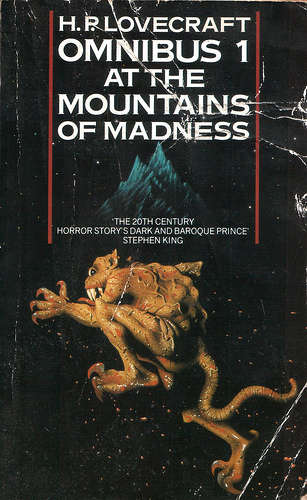
One of my favourite memories of Atlas is walking in, after finding out about HP Lovecraft, and asking if they stocked any. The old guy who ran the place literally laughed in my face and said "Good luck finding any of his work, mate" - this was back in 1995ish, when Lovecraft's work wasn't readily available in bookstores like it is nowadays (at least, not in any of the ones I went in). "Isn't that something by him?" I asked, pointing to a collection on the cluttered shelf behind him. "Oh yeah," he said, before selling me it. The plank. It was this:


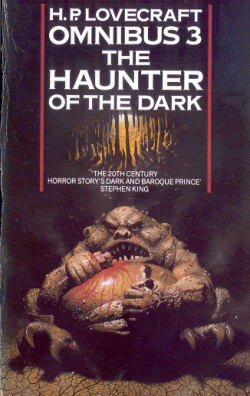
I then set about hunting down the others in this series, namely:


This last cover is my favourite one. I honestly can't remember how I got into Lovecraft, which in itself is a bit Lovecraftian - like I heard his name whispered in dark corners, and it gradually worked its way into my consciousness until it consumed me. I do have a 'Lovecraft special' copy of Fangoria that I may have picked up before finding his stories, but I can't be sure. In any case, I found his voice, being as it is from the early part of last century, refreshing after reading a hell of a lot of 70s pulp horror (which I do still read on occasion).

Thanks to Lovecraft, I developed a taste for others of his ilk, such as Algernon Blackwood (it's maybe cliche to say, but 'The Willows' by him is excellent and shit scary) and Robert E. Howard. This was also helped by reading old Pan Horror anthologies, which I still collect if I happen to stumble across any.

In an unexpected way, Barker and Lovecraft share the fact they've had a lot of their work adapted for film, although not always precisely (for Barker, see: Rawhead Rex as a case in point). I find this particularly interesting for Lovecraft, as there used to be numerous films in the pipeline based on his work, but none of them ever came to fruition (such as a film of Shadow Over Innsmouth, though Stuart Gordon's DAGON presents a more than adequate version of this). There is, famously, now a 'Cabal' cut of Nightbreed, that apparently represents a non-studio-butchered version that's closer to the source material, though I've heard it's lacking in visual/audio quality, unfortunately.

But at least someone out there had the passion to see it through. I don't think horror is the only genre where fans have such an enthusiasm that they'll do stuff like this, but it appears to affect the genre more than any other - perhaps because, by its very nature, horror is often censored or cut or edited or what-have-you, and someone, somewhere, will want to know what the 'real' story/film is like. Curiosity is perhaps our species' greatest trait, but also our weakest. That sounded better in my head.

Anyway, enough of that. I've now been reminded of an old kids' show I used to watch back in the 80s called The Curiosity Show. I couldn't remember the full name, only that the title music had someone singing 'curiosity', so thank the universe for the internet! I'm sure I used to watch this in London, but with it being an Australian show, I probably watched it when I lived there (unless it was syndicated). I remember making origami flowers that opened when you put them on water - it's maybe on Youtube somewhere, but for now, have THIS! --->


And as per usual, some music to end with: